


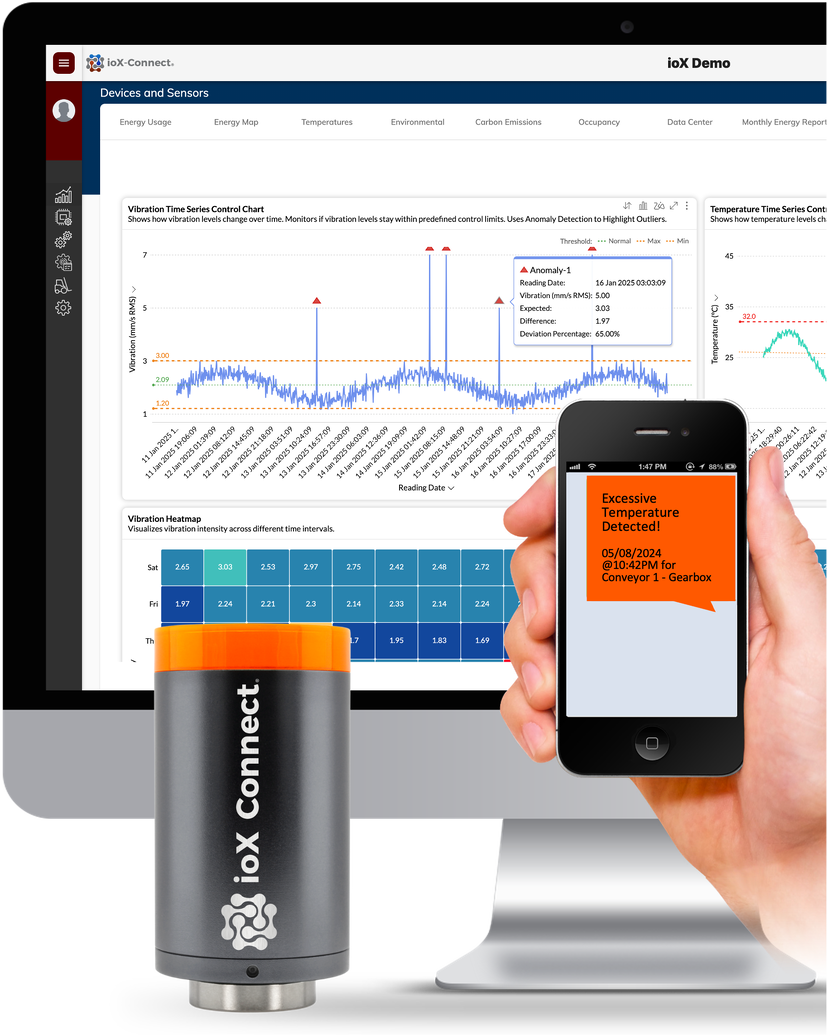
An IoT vibration sensor is a small wireless device that mounts on a motor, pump, fan or gearbox, measures how the machine is vibrating, and sends those readings to software on a schedule. Because most mechanical faults change a machine's vibration weeks before it fails, a rising trend gives your maintenance team time to plan a repair instead of reacting to a breakdown.
This guide covers what the sensors measure, which faults they catch, and how to turn readings into alerts your team acts on. If you already know you want sensors on a line, see the ioX-Connect LoRaWAN vibration and temperature sensor.
Benefits of wireless vibration monitoring
Unplanned downtime on rotating equipment is expensive for reasons that have little to do with the part itself: a stopped line, overtime for the repair crew, expedited shipping on a bearing, and sometimes damage to the machine next to the one that failed. Vibration is the earliest practical warning for the most common mechanical faults, which is why it sits at the center of most condition-based maintenance programs.
Traditional vibration analysis relies on route-based readings: a technician visits each machine with a handheld analyzer every few weeks. That works, but a fault that starts the day after a visit goes unseen until the next one. Wireless sensors close that gap by staying on the machine and reporting continuously on a schedule you set.
What an IoT vibration sensor measures
An industrial vibration sensor uses an accelerometer to sample movement on three axes. Rather than sending raw waveforms over a low-power radio, a good sensor calculates summary values on the device and sends those. The ioX-Connect LoRaWAN Vibration and Temperature Sensor, for example, calculates these on board:
- Velocity RMS: the overall vibration level, and the value most severity guidelines are written around.
- Acceleration RMS and peak: sensitive to higher-frequency events such as early bearing damage and impacts.
- Displacement: how far the surface moves, useful on slower machines.
- Kurtosis and crest factor: how spiky the signal is; both tend to rise with bearing defects before the overall level does.
- Skewness and standard deviation: further shape statistics for trending.
It also measures temperature at the mounting base, which is useful because a failing bearing usually runs hotter as well as rougher. The sensor covers 10 Hz to 1,000 Hz, operates from -20°C to 80°C (-4°F to 176°F) in an IP66 enclosure, and mounts by stud, mounting pad or adhesive.
Faults vibration monitoring catches early
Imbalance
Uneven mass on a fan, impeller or rotor produces vibration at running speed. It loads the bearings on every revolution and shortens their life.
Misalignment
When coupled shafts are out of line, the machine works against itself. The result is extra vibration, heat in the coupling and bearings, and higher energy use.
Bearing wear
Damage on a race or rolling element starts small. Kurtosis, crest factor and peak acceleration usually react first, and the overall level and temperature follow as the damage grows.
Looseness
Loose hold-down bolts, a cracked base or worn fits let the machine move more than it should, which shows up as a jump in vibration that often appears on one axis more than the others.
Gear wear
Worn or damaged gear teeth add impacts on every mesh, which raises peak acceleration and the spikiness of the signal.
How to turn readings into maintenance alerts
Readings only prevent failures if someone acts on them. A practical setup has three parts:
- A baseline per machine. Record a few weeks of normal running. Every machine vibrates differently, so the alert level should come from the machine's own history, guided by a severity standard such as ISO 20816 for the overall level.
- Alerts on a sustained rise, not a single spike. A start-up or a passing forklift can produce one high reading. Alert when a value stays above the limit for a while, and send a second notice when it returns to normal.
- The right people, the right channel. Route alerts to the maintenance planner by email and to the on-call technician by text, and keep a record of when each alert fired and cleared.
In ioX-Pulse workflows you build exactly this: a condition on any sensor value, a recovery delay so an alert clears only once the reading is back to normal, a limit on how often one device can fire, and actions that send email or SMS to notification groups. Sensor readings also feed dashboards, so the planner sees the trend behind every alert.
Pro tip: mount the sensor on the bearing housing nearest the load, on clean, flat metal. A stud mount transmits high-frequency vibration most faithfully; adhesive and mounting pads are quicker to install and suit trending overall levels.
Where IoT vibration monitoring pays off
- Manufacturing: motors, conveyors and gearboxes on production lines.
- Water and wastewater: pumps and blowers at remote lift stations no one visits daily.
- Facilities and data centers: air handlers, cooling tower fans and chillers.
- Oil and gas, mining: compressors, crushers and pumps in places where a site visit takes hours.
Frequently asked questions
What does an IoT vibration sensor measure?
A three-axis accelerometer samples the machine's movement and the sensor turns it into summary values such as velocity RMS, acceleration RMS and peak, displacement, kurtosis and crest factor. Most industrial models also measure surface temperature at the mounting point.
How is wireless vibration monitoring different from route-based vibration analysis?
A technician with a handheld analyzer collects a reading per machine every few weeks. A wireless sensor stays on the machine and reports on a schedule, so a change that starts between two route visits is seen the day it starts.
Which machines should get vibration sensors first?
Start with rotating equipment whose failure stops production or is expensive to repair: motors, pumps, fans, compressors and gearboxes, especially the ones with no spare and no redundancy.
Do I need a vibration analyst to use the data?
Not to get started. Trending one or two values per machine and alerting on a sustained rise catches most developing faults. An analyst adds value later, when you want to identify the exact fault from the spectrum.
Next step
Pick the three machines that would hurt most if they failed tomorrow and start there. Talk to an IoT specialist about sensor placement and alert levels for your equipment, or see ioX-Pulse plans to monitor the readings yourself.
ioX-Connect
ioX-Connect is a comprehensive IoT Management Platform designed to streamline the monitoring of facilities and equipment.
Topics from this blog: Vibration Analysis Predictive Maintenance