


To manage indoor air quality in an office or commercial building, measure CO2, fine particles (PM2.5 and PM10), TVOC, temperature, humidity and occupancy in the rooms people use, then act on sustained changes against your own baseline. There is no single number that says the air is good. Each measurement answers a different question, and the useful ones are the ones you compare over time and between rooms.
This guide covers what each reading tells you, what the published references actually say, and how to set alert levels a facilities team can use. It is written for the people who take the call when a floor feels stuffy.
Start with CO2, and read it as a ventilation signal
CO2 is the most common indoor air quality reading and the most commonly misread. People breathe it out, so it rises when a room fills and falls when fresh air replaces it. That makes it a good indicator of whether ventilation is keeping up with occupancy.
It is not a measure of overall air quality. In its 2023 position on the subject, ASHRAE says indoor CO2 concentrations do not give an overall indication of indoor air quality, and that it is incorrect to say Standard 62.1 requires CO2 below a threshold such as 1,000 ppm. ASHRAE also notes that readings far above expected ranges may mean the ventilation system is not working properly. That is the practical use: know what is normal for a room, and investigate when it moves away from normal.
The regulatory ceiling is much higher and is about worker exposure, not comfort. OSHA sets the permissible exposure limit for carbon dioxide at 5,000 ppm as an 8-hour time-weighted average.
Track PM2.5 and PM10 for particles
Fine particles come in from outdoors and from activity inside the building. They are a separate problem from CO2: a well-ventilated room next to a busy road can have low CO2 and high particle counts.
No US limit applies to office air specifically, so many teams use the WHO 2021 air quality guidelines as a reference. They are written for ambient air: 5 µg/m³ annual mean and 15 µg/m³ 24-hour mean for PM2.5, and 15 µg/m³ annual mean and 45 µg/m³ 24-hour mean for PM10. A rising reading in one zone often points to a filter or a local source, which is why comparing zones matters more than any one figure.
Treat TVOC as a trend
Volatile organic compounds come from cleaning products, paints, furniture and stored materials. EPA notes that concentrations of many VOCs are consistently higher indoors, up to ten times higher, than outdoors, and that no federally enforceable standards have been set for VOCs in non-industrial settings.
TVOC sensors report a combined signal rather than individual chemicals, so use the reading to spot change: after a renovation, a new cleaning contractor or a delivery of new furniture.
Keep humidity and temperature in view
EPA advises keeping indoor humidity between 30 and 50 percent. Temperature and humidity are also what occupants notice first, so logging them gives you context when complaints arrive.
When to act: set alerts from your own baseline
Because the published references are not office action levels, the most useful alert levels come from your own building:
- Collect two to four weeks of readings across normal working days before you set anything.
- Compare by room type. A boardroom and an open-plan floor behave differently.
- Alert on sustained change, not spikes. A CO2 rise during a full meeting is expected. CO2 that stays high after the room empties, or high readings in a lightly used room, points to ventilation.
- Pair air data with occupancy. It separates a full room from a fault.
- Send each alert to the person who can fix it, and keep the history for the next review.
One sensor per room
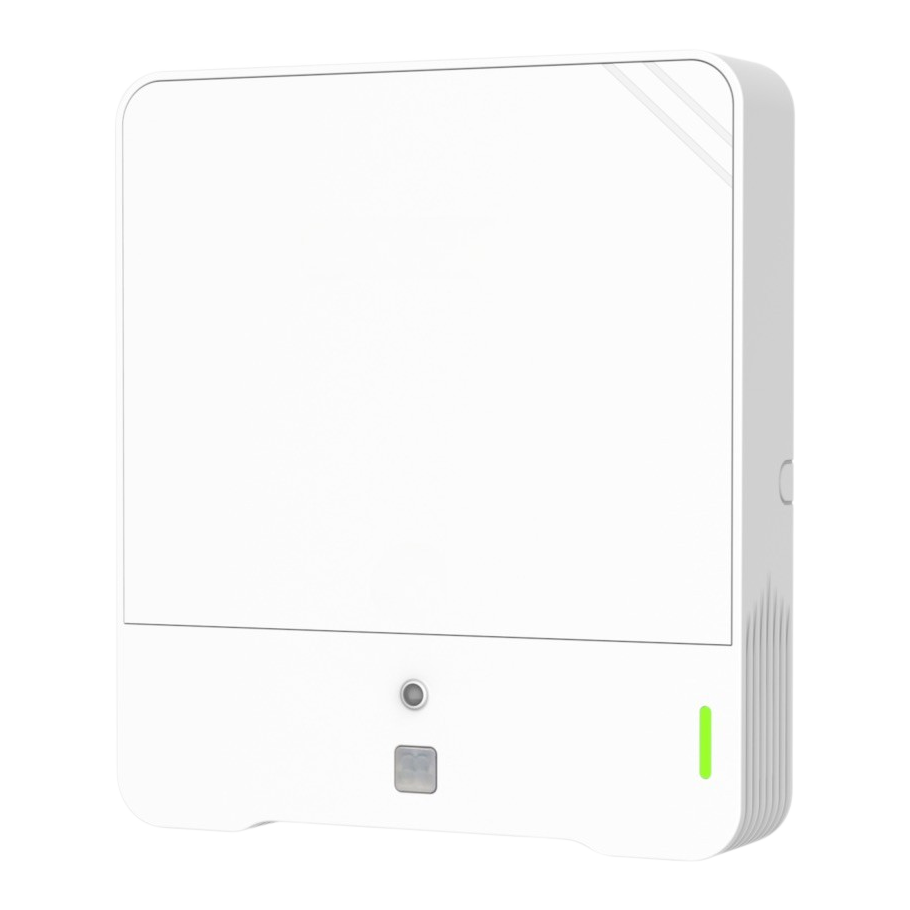
The LoRaWAN Air Quality (9-in-1 IAQ Sensor) measures CO2, TVOC, PM2.5, PM10, temperature, humidity, pressure, light and occupancy in one wall-mounted device. A traffic-light LED and buzzer warn the people in the room, and readings go over LoRaWAN to ioX-Pulse, where your team can compare rooms and set alerts. If you only need ventilation data, the LoRaWAN CO2 sensor is the simpler choice. See all of our LoRaWAN air quality sensors.
Frequently asked questions
What should you measure for indoor air quality in an office?
Measure CO2 as a ventilation signal, PM2.5 and PM10 for fine particles, TVOC for gases from products and materials, plus temperature and humidity for comfort. Add occupancy so you can tell a busy room from a ventilation fault.
Is 1,000 ppm CO2 the legal limit for offices?
No. ASHRAE says it is incorrect that Standard 62.1 requires CO2 below a threshold such as 1,000 ppm, and that indoor CO2 does not give an overall indication of air quality. The OSHA permissible exposure limit for CO2 is 5,000 ppm as an 8-hour time-weighted average.
What PM2.5 level should you aim for indoors?
No federal US limit applies to office air. A useful reference is the WHO 2021 guideline for ambient air: 5 µg/m³ as an annual mean and 15 µg/m³ as a 24-hour mean for PM2.5. Compare rooms with each other and with outdoor readings.
What humidity should an office keep?
EPA advises keeping indoor humidity between 30 and 50 percent.
Plan your rollout
Tell us about your building and we will help you choose where sensors should go. Talk to an IoT specialist, see the 9-in-1 sensor, or see ioX-Pulse plans.
Topics from this blog: Air Quality LoRaWAN IoT