


The total cost of ownership (TCO) of an IoT sensor system is the sum of five things: hardware, connectivity, software subscriptions, installation, and ongoing maintenance, added up over the life of the deployment, usually five years. The purchase price of the sensors is typically the smallest of the five. Connectivity fees and maintenance labor are where most budgets go wrong, and they are also where the choice of wireless technology makes the biggest difference. This guide walks through each cost category and gives you a simple framework to compare vendors and technologies on equal terms.
The five cost categories of IoT TCO
1. Hardware
Sensors, gateways, mounting brackets, CT clamps, probes and antennas. Two questions decide the real hardware cost: how long the devices last, and how many gateways you need. A battery-powered LoRaWAN sensor commonly runs for years on one battery and hundreds of devices can share a single gateway, so the per-device infrastructure cost falls as the deployment grows. Low-cost hardware with a high failure rate is the classic false economy: every early failure adds a truck roll, and the labor usually costs more than the replacement device.
2. Connectivity
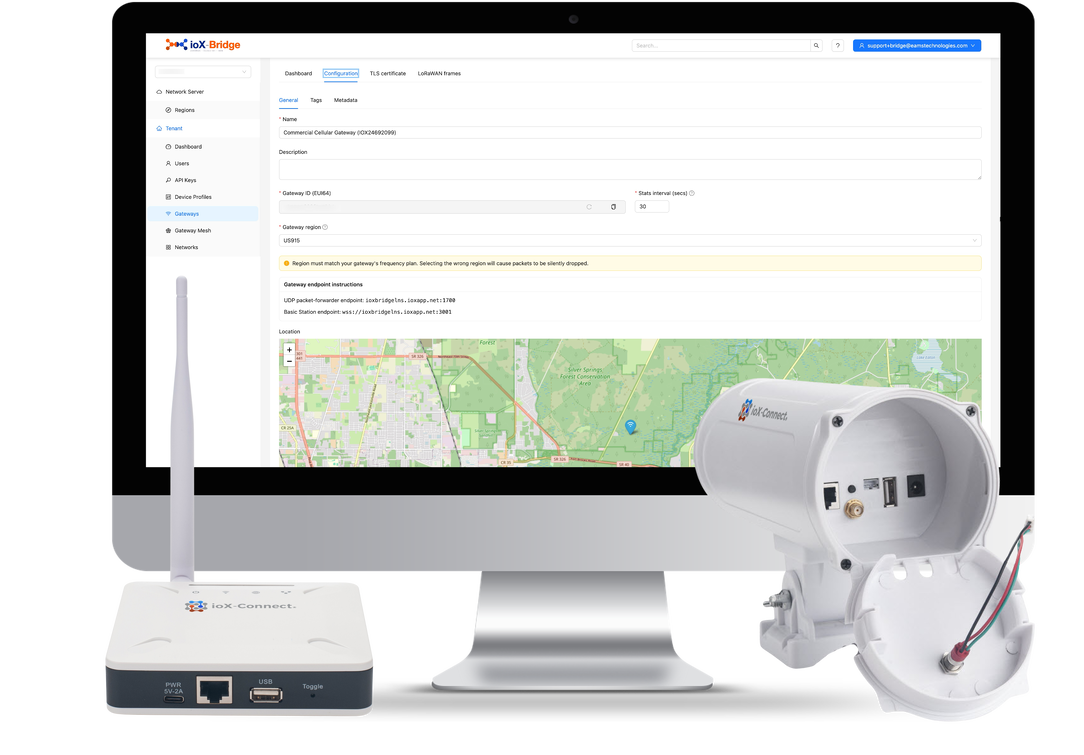
This is the category that separates the technologies. With cellular IoT, every device or gateway carries a SIM and a recurring data plan, and those fees run for the life of the project. With LoRaWAN sensors, the sensors themselves pay no carrier fees: they talk to your gateway over license-free spectrum, and only the gateway needs a backhaul connection, which can be your existing network, Wi-Fi or a single cellular plan. A hybrid design, battery LoRaWAN sensors reporting through one cellular-backhaul gateway, is often the lowest-TCO way to cover a site with no reliable network access.
3. Software
The platform that stores readings, draws dashboards and sends alerts is a recurring cost, and it is the one vendors structure most differently: some charge per device, some meter data points or API calls, some charge flat plan prices. Metered pricing is hard to budget because the bill moves with your reporting interval. When you compare plans, normalize to one number: cost per device per month at YOUR reporting interval, over five years. You can see how ioX-Pulse structures its plans as flat monthly prices with device seats, which keeps that calculation simple.
4. Installation and commissioning
Wired sensors cost more to install than they cost to buy; wireless sensors invert that. Budget for site survey, gateway placement, device mounting, naming conventions and dashboard setup. A deployment that arrives pre-provisioned, with devices already registered against device profiles, cuts commissioning to mounting and a signal check.
5. Maintenance and operations
Battery replacement rounds, firmware updates, failed-device swaps and the staff time to check that data is still flowing. Ask every vendor three questions: what is the realistic battery life at my reporting interval, can firmware be updated over the air, and does the platform alert me when a device goes quiet? A system that silently stops reporting costs you twice, once in missed readings and once in the incident you did not catch.
A simple TCO formula
For each option you are evaluating, fill in one line:
5-year TCO = (hardware + installation) + 60 x (monthly connectivity + monthly software) + (expected battery and replacement cost over 5 years)
Then divide by the number of measurement points to get a cost per point, which is the only number that compares a 10-sensor pilot fairly against a 300-sensor rollout. Run the same line at double your device count: metered and per-device pricing models scale very differently, and the lowest-price option at 20 devices is often the most expensive one at 200.
Where cellular IoT fits
Cellular remains the right call when devices are mobile, spread across sites you do not control, or too far apart to share a gateway: think vehicle trackers or a single remote pump station. For dense deployments inside facilities you control, the recurring per-device carrier fees usually make cellular the most expensive option over five years, which is why most facility monitoring projects land on LoRaWAN with a cellular-backhaul gateway only where wired internet is unavailable.
Frequently asked questions
What drives IoT total cost of ownership the most?
Recurring costs. Over five years, connectivity fees, software subscriptions and maintenance labor normally outweigh the upfront hardware purchase. Comparing vendors on device price alone almost always picks the wrong system.
How do I calculate IoT connectivity costs over a five-year roadmap?
Count the SIM-carrying devices, not the sensors. In a LoRaWAN design only the gateway needs backhaul, so connectivity cost is one plan per site. In a cellular-per-device design it is one plan per device. Multiply each by 60 months and add planned growth at the same rate.
Is LoRaWAN cheaper than cellular IoT?
For fixed sensors concentrated at sites you control, usually yes, because sensors carry no carrier fees and share gateways. For mobile or widely scattered single devices, cellular can be cheaper because it needs no gateway at all. Many real deployments mix both.
What hidden costs should I look for in an IoT quote?
Metered data or API overage fees, per-user or per-dashboard charges, battery replacement labor, fees for exporting your own data, and the cost of integrating readings into existing systems. Ask for the all-in price at your reporting interval in writing.
Next step
If you are budgeting a monitoring project and want a second pair of eyes on the numbers, talk to an IoT specialist. We will price the same deployment both ways, cellular and LoRaWAN, so you can compare the five-year totals before you commit.