Remote IoT monitoring solution for facilities and equipment

Collect. Analyze. Act.

A remote IoT monitoring solution puts wireless sensors on the equipment and spaces you are responsible for and sends every reading to software you can open from anywhere, so you see a problem the moment a limit is crossed instead of on the next walk-round. ioX-Pulse is that software: live dashboards, alerts by email or text, and a full history for every sensor, across one site or many.

Talk to an IoT Specialist  |  See ioX-Pulse plans

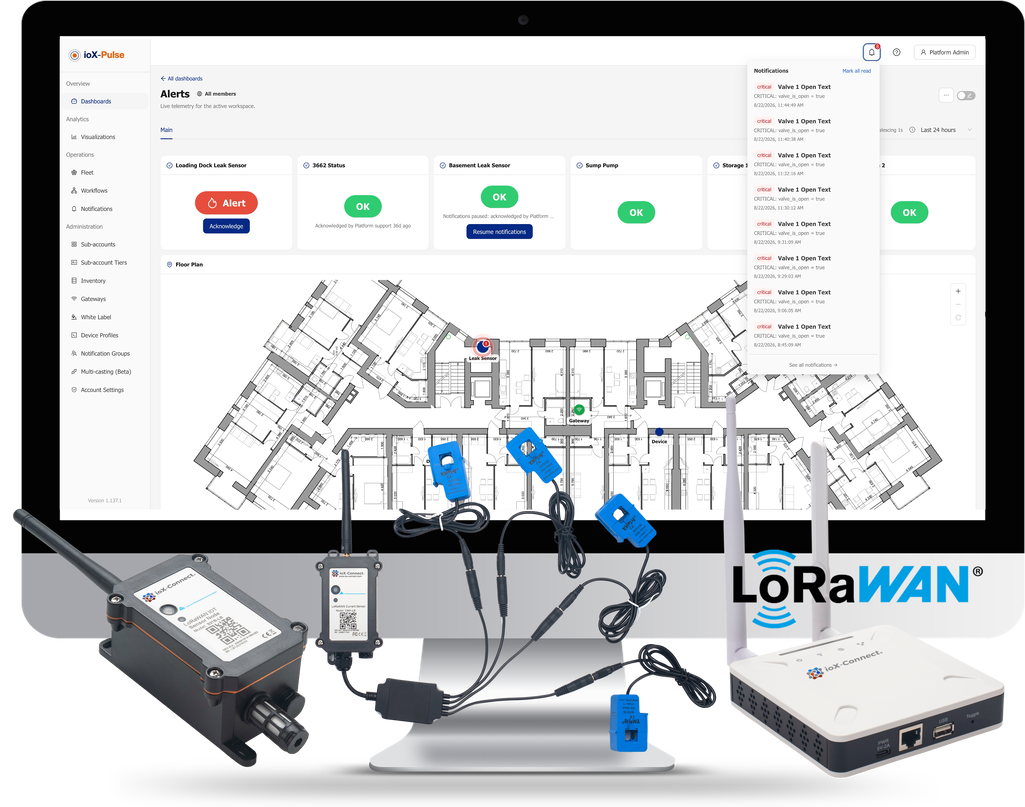
ioX-Pulse remote IoT monitoring software showing live sensor status on a floor plan
ioX-Pulse

Remote IoT monitoring software for wireless sensors

ioX-Pulse is remote IoT monitoring software. Your wireless sensors report through a LoRaWAN gateway into ioX-Pulse, which turns each reading into a live dashboard tile, an alert to email, text message or webhook when a reading crosses a limit you set, and a searchable history of every value.

It runs the LoRaWAN sensors we sell, and plans with external sensor integration run third-party LoRaWAN hardware from a versioned device profile library, so an evaluation can start with sensors you already own.

You set up devices, sites and alert workflows to match your operation, share a dashboard with the people who need it, and replace manual rounds with readings you can trust.

What IoT monitoring software does

IoT monitoring software collects readings from wireless sensors, shows them on live dashboards, raises an alert when a reading crosses a limit you set, and keeps the history so you can see what changed and when. ioX-Pulse is that software. Your sensors report to a LoRaWAN gateway, the gateway forwards the data to ioX-Pulse, and you work with it in a browser.

Getting a reading on screen does not mean writing code. If your device is in the manufacturer profile library, its payload is decoded for you, and a profile can be built for a device that is not. Dashboards are assembled from widgets you place on a grid. Workflows watch for the conditions you care about and send email, in-app or SMS alerts to the people you name, with a repeat window and a per-device ceiling so one faulty sensor cannot flood an inbox. Calibration and formula fields are there for when a deployment gets specific.

See ioX-Pulse plans or Talk to an IoT Specialist about your site.

How the data gets to you

Enhance your equipment with wireless sensors, or place them in the areas you need to watch, and they report on a schedule you control. The sensor data travels to a LoRaWAN gateway, which forwards it to ioX-Pulse for storage, display and alerting. The same readings drive the dashboard tile, the alert and the history chart, so there is one number rather than three.

ioX-Pulse is a browser application, so there is nothing to install on a workstation. Sites and networks group your devices the way your operation is actually laid out, roles control who sees and changes what, two-factor sign-in can be made mandatory, and an audit log records the changes people make. A dashboard can also be shared as a read-only link for a wallboard or a customer, with no sign-in required.

Sensors that report to ioX-Pulse

Who uses remote IoT monitoring, and for what

Facility managers, maintenance teams and operations leads use ioX-Pulse when the thing they are responsible for is somewhere they cannot watch all day: server rooms and data centers, cold rooms and freezers, plant rooms, pump stations, warehouses and multi-site property portfolios.

Typical remote monitoring jobs: temperature and humidity in server rooms and cold storage, water on the floor under raised floors and next to water heaters, vibration and temperature on motors and pumps, energy use per circuit, and doors left open after hours. Each one is a sensor reading, a limit, and the right person told in time. Pick the sensors below; they all report into the same ioX-Pulse workspace.

LoRaWAN Water Flow Sensor

LoRaWAN Device Range

Explore our large range of LoRaWAN Devices and Sensors

Enhance your asset monitoring capabilities with the ioX-Connect Vibration Sensor, an industrial-grade wireless vibration sensor designed to detect early signs of mechanical failure.

Vibration Monitoring

Industrial Vibration Sensor

Sensor Gateway

RF IoT Sensor Gateways

RF Sensor Gateways

Temperature Sensor

Wireless RF Sensors

Wireless RF sensors for temperature, humidity, water and access
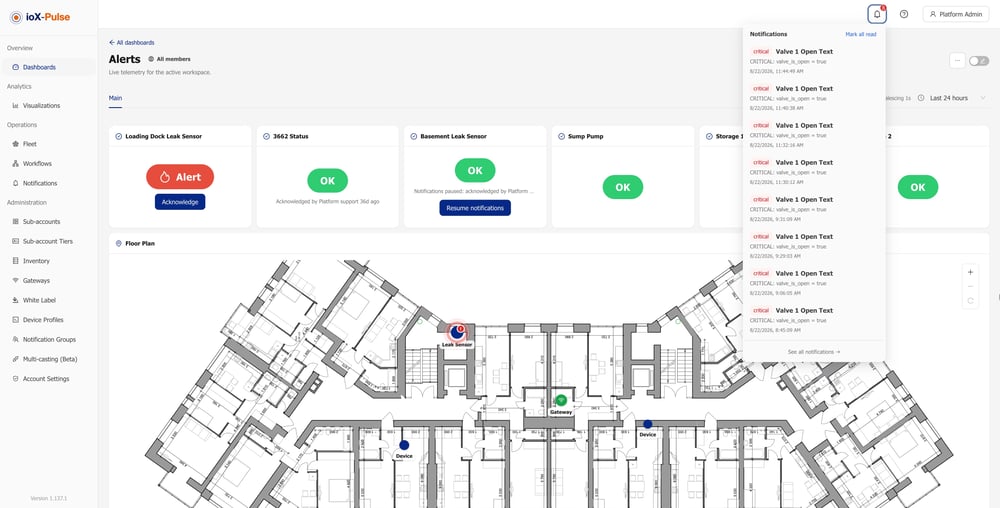
ioX-Pulse dashboard with a leak sensor in alarm on a floor plan and the notifications list open

Live dashboards for every site

Each site, room or asset gets a dashboard that updates as readings arrive: status tiles that turn red when a sensor is in alarm, gauges, charts and a floor plan that shows exactly which sensor raised the alert. Your team acknowledges an alert from the same screen, and a dashboard can be shared as a browser link for people who do not need a login.

Alerts that reach the right person

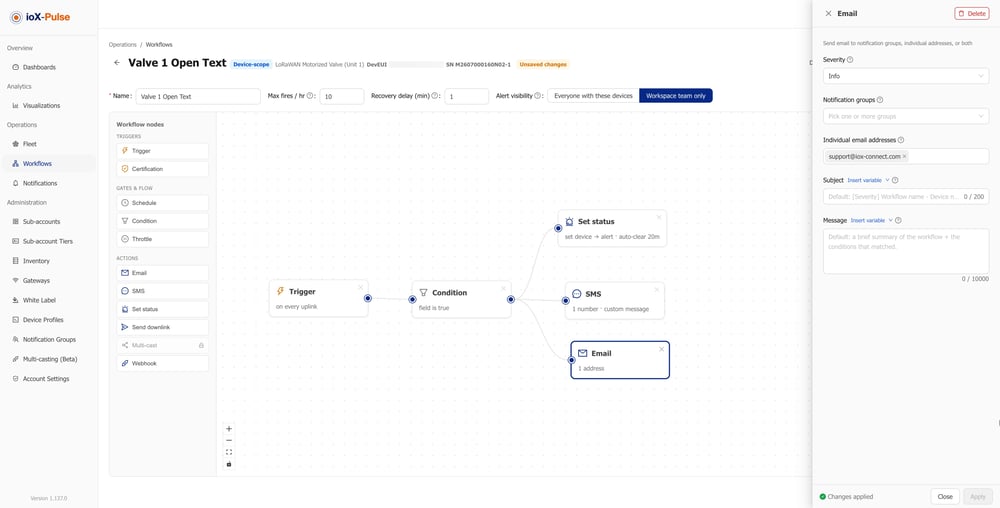
Workflows decide what happens when a reading crosses a limit: send an email or text to a notification group, call a webhook, set a device status, or send a command back to a device such as closing a valve. A recovery delay and a per-device limit on how often an alert can fire keep a noisy sensor from flooding your phone.

ioX-Pulse workflow editor with a condition that sends SMS and email and sets a device status
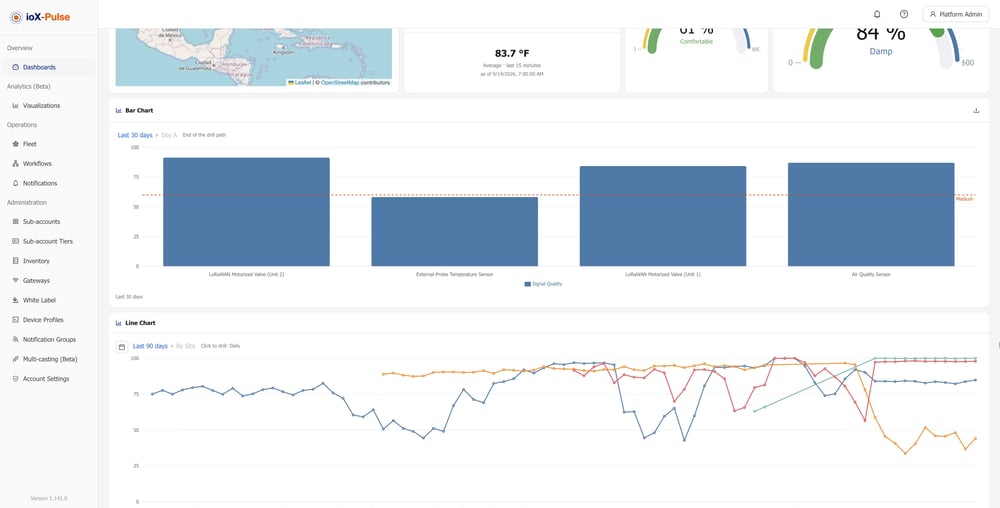
ioX-Pulse dashboard with bar and line charts of sensor history across devices

History you can report on

Every value every sensor sends is kept, so you can chart a week or a quarter, compare sites and devices side by side, and download the data as CSV for an audit or a maintenance review. Charts can sit on a dashboard next to the live tiles, so the trend and the current reading are on one screen.

FAQs

Frequently asked questions about IoT monitoring software

Most questions about IoT monitoring software come down to the same few things: how far the sensors reach, how long their batteries last, whether the software will work with hardware you already own, and who can see the data. Those come up in nearly every evaluation, so they are answered directly below. Anything else, email sales@iox-connect.com and a specialist will answer.

IoT monitoring software receives readings from connected sensors, stores them, shows them on dashboards, and raises an alert when a reading crosses a limit you set. ioX-Pulse does this for LoRaWAN and cellular sensors: the sensor reports to a gateway, the gateway forwards to ioX-Pulse, and you read and act on the data in a browser. See ioX-Pulse plans.

A monitoring system is the whole arrangement: sensors, a gateway, a network and the software. The software is the part you log in to. ioX-Pulse is the software. It works with ioX-Connect LoRaWAN sensors and with standards-compliant gateways from other manufacturers, so you can buy the hardware and the software together or bring hardware you already own.

It depends on what is between them. LoRaWAN is designed for long range at low power, and outdoor line-of-sight links of several kilometers are normal, while a sensor inside a plant room with steel and concrete around it may need a gateway on the same floor. The practical answer for a specific site comes from a survey rather than a range figure, and every device in ioX-Pulse carries a signal quality score so you can see which ones are marginal before they drop out.

Gateway capacity is set by airtime, not by a fixed device count. A gateway carries far more devices that report every hour than devices that report every minute, and devices further from the gateway use more airtime per message. Size the reporting interval to what you actually need to see, and add a gateway where the site is large or the radio path is difficult.

Battery life depends mainly on three things:

  • Reporting interval: how often the sensor sends a reading.
  • Distance to the gateway: a longer link costs more energy per message.
  • Obstructions in the radio path: walls and metal make the radio work harder for the same message.

Reporting intervals are adjustable where the device profile supports it, so you can trade resolution for battery life deliberately rather than by accident.

Yes, on the Pulse Pro plan, which includes external sensor integration. The device profile library already covers major LoRaWAN manufacturers, and a profile can be built for a device that is not in it yet. Non-LoRaWAN devices are supported too, including cellular NB-IoT and LTE-M devices identified by IMEI. Talk to an IoT Specialist about your existing hardware.

LoRaWAN encrypts every message end to end with AES-128 session keys, so the payload is not readable between the sensor and the network server. Inside ioX-Pulse, access is controlled by role, two-factor sign-in can be made mandatory for everyone in an account, and an audit log records who changed what. API keys are scoped, and webhook deliveries are signed with HMAC-SHA256 so the receiving system can verify them.

Yes. A dashboard can be published as a browser link that needs no sign-in, either open or password protected, and it is read-only unless you deliberately enable controls on a protected link. The link can be replaced or switched off at any time, which makes it a practical way to run a wallboard or to give a customer a view of their own site.

Have more questions about

Our Products and Services

We're here to help. Reach out and an IoT specialist will get back to you.

Contact Us

Our customer service representative helps you to understand what we offer for your business goals.